Types of trading to avoid while in debt
Being in debt is not strange. Mortgages, student loans, business loans and the odd miserable credit card balance are pretty standard. The problem starts when you try to use trading as a way out of that hole.
On paper the logic sounds clean. “If I can pull a few good trades together, I clear this card, get rid of that loan, and then I’m free.” In practice, debt changes how you react to risk and how risk punishes you when it goes wrong. The same trade that would be mildly annoying in a clean balance sheet can become a serious problem when you are already committed to fixed repayments, fees and interest.
Different trading styles amplify that problem in different ways. Some add massive leverage on top of borrowed money. Some lock you into all-or-nothing payoffs. Some rely on low-probability disasters not happening for a very long time. In a normal account that might already be too much. In a debt-heavy situation it is asking for trouble.
This is not about saying “never trade if you have any debt at all”. It is about recognizing which types of trading are structurally hostile to someone who already owes money, and why they are worth avoiding until your basic finances are on safer ground.
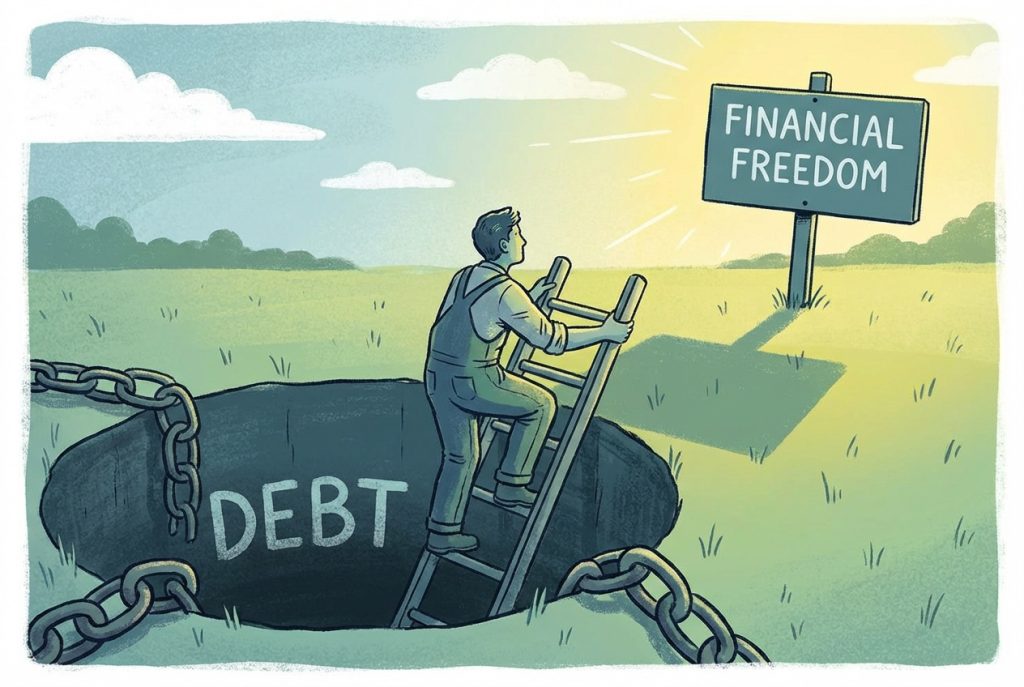
Why trading while in debt is a bad match
Trading always carries risk of loss. That is obvious, but when you have no significant obligations it is easier to absorb the swings. You can reduce size, take a break, re-build slowly. Debt changes that because outflows are now fixed. Credit card companies do not care that you had a bad week in EURUSD or on some meme coin. The minimum payment is still due, with interest ticking.
That fixed schedule shrinks your margin for error. Every loss eats into money that was already committed to something else. If you start using trading capital to plug repayment gaps, your account becomes a revolving door. You add funds, blow up again trying to “fix” the new hole, and the cycle gets tighter.
Debt also hits your decision making. The urge to get out quickly pushes you toward high-risk, high-leverage, short-term trades that promise big moves in a short window. You start thinking in terms of “I just need this one trade to work”, which is the opposite of the boring, repeatable edge trading actually needs.
On top of that, certain types of trading line up almost perfectly with the emotional profile of someone under pressure. Fast binaries, highly geared intraday forex, tiny volatile coins, news gambling. They are marketed as quick paths to a fresh start, which is a nice way of saying they are casinos wearing charts.
Once you accept that debt narrows your safety zone, the next step is to pick out which trading types compress that zone further until it basically disappears. Those are the ones you park until the balance sheet stops screaming.
High-leverage intraday forex and CFD trading
What the product looks like
Retail forex and CFD platforms sell a simple story. Tight spreads, low margin requirements, twenty-four hour access on the major pairs and indices, all from a phone. You put up a small margin deposit and control a much larger notional position. A move of half a percent in the underlying can produce an account move of ten percent or more if you are using the higher multipliers on offer.
On a clean balance sheet, that is already dangerous if you do not have a tested method and risk rules. Add existing debt and things get worse. Margin lets you magnify both wins and losses, but when losses hit you are not only down in the account, you are also still on the hook for your previous obligations.
Because intraday forex and CFDs run around the clock, the temptation is to keep “having another go” after a loss. You can always open one more small position in the Asian session, or on that late US move, or into a minor news release. Small positions backed by high leverage look cheap in notional terms, but the relative risk to account equity is large.
You can learn more about how CFD and Forex trading work by visiting DayTrading.com. DayTrading.com features extensive articles and guides on both of these types of trading.
Why leverage plus debt is a rough mix
The core issue is that leverage multiplies drawdowns faster than you can repair them from normal income, specially when that income is already committed to repayments. A trader with no debt can decide to cut risk to a tiny level after a setback and slowly rebuild with a clear head. A trader with debt tends to feel that slow repair is not enough, so they keep size high to try to speed things up.
That combination often ends in a spiral. You raise leverage after losses to “get the money back”. You then hit normal losing streaks and standard volatility, but now each move against you takes five or ten times the bite. Soon the account is too small to trade your original size sensibly, and you either stop or add more capital from money that should have gone toward debt.
The second issue is time. Intraday CFD styles demand attention. If you are already working extra hours or juggling side jobs to manage repayments, your available focus shrinks. Trading tired, stressed and distracted is exactly how you end up chasing bad entries and ignoring stops.
In short, high-leverage intraday forex and CFD trading amplifies every weakness that comes with being in debt: urgency, limited capital, emotional swings and lack of spare mental bandwidth. That is not a mix you want.
Short-term options, binaries and “all-or-nothing” bets
Expiry pressure and payout profiles
Short-dated options, turbo products and binary style contracts share one trait. You stake a defined amount on a yes-or-no event in a short time window. For binaries and similar contracts, the payoff is literally all or nothing. You either lose the entire stake, or you receive a fixed amount back. For very short-dated options, practical results are not much different if you are trading them like lottery tickets into news.
These payoffs look attractive when you are thinking “I just need to double this small account and I’m fine”. The marketing leans into that feeling, talking about high potential percentage returns per trade. What tends to get downplayed is the required hit rate and the impact of fees and spreads over many trades.
Under realistic assumptions, the structure is stacked. Payouts are set so that you need to win far more than half your trades just to tread water. Most people do not. When you are already in debt, you are typically not in a calm, analytical frame of mind suited to dissecting implied probabilities and risk reward. You are thinking in single-trade goals.
Psychology when you are already under pressure
All-or-nothing payoffs interact badly with a “must win” mindset. If you are owed money and under constant reminders from creditors, you are primed to chase relief. Short-term options and binary trades promise that relief in one move.
The problem is that losses hit your mood and your balance harder. A few losing binaries in a row can wipe a meaningful chunk of the account very quickly. That pain makes you either freeze and stop out of everything, or tilt and double size into the next trade to try and patch the damage. Both reactions are driven by stress, not by any structured edge.
Expiry clocks also mess with your patience. Swing or position trades give you time to think in terms of risk and reward over days or weeks. An instrument that expires every minute or every hour drags you down to that timescale. If you combine that with debt-driven urgency, you end up taking too many trades for reasons that have nothing to do with your method.
If you are going to trade options at all while in debt, longer-dated, small-size positions structured with defined, tolerable risk have at least some logic. Treating short-dated options or binaries as a way to blast out of a financial hole is closer to betting than to trading, just with charts as window dressing.
Futures and crypto perpetuals as debt multipliers
Contract structure and margin
Futures contracts and crypto perpetual swaps are standard tools for professional traders. They are also very efficient ways to multiply both gains and losses. One index future or one bitcoin perpetual often controls a large notional amount. Exchanges set initial and maintenance margin levels that are only a fraction of that notional.
In crypto, some offshore venues have advertised very high position multipliers. Even where caps are now lower on paper, it is still normal to see ten or twenty times effective leverage used by retail accounts. That is on top of underlying assets that can swing several percent in a day by themselves.
When you are in debt, controlling a six-figure notional position off a four-figure margin deposit is more than just ambition. It is loading a very volatile contract on top of an already leveraged personal balance sheet.
Liquidations, gaps and overnight moves
The mechanics of futures and perpetuals are unforgiving. If price moves against your position and your account equity drops below maintenance margin, positions can be liquidated automatically. That liquidations process does not wait to see whether the market bounces back in the next hour. It is triggered by numbers, not your personal situation.
Debt makes that dynamic worse because you are less able to top up margin in a calm way. You may feel forced to risk a large portion of the remaining account on a single position just to delay a margin call. If that position goes wrong, the account is gone.
Overnight and weekend risk also bites harder. Index and commodity futures can gap on macro news. Crypto trades non-stop but liquidity can change sharply during thin hours, so wicks and slippage become more violent. When you are already committed to repayments and other bills, a sudden forced liquidation is not just a trading annoyance, it can blow a hole in your month.
For traders with solid capital, clear rules and no personal debt pressure, these products are workable tools. For someone already carrying obligations, they are a high-voltage line best left alone until the rest of your finances are not loaded with their own leverage.
Martingale, grid and “double until it works” styles
Why they look safe on paper
Martingale and related doubling strategies have a strange charm. On a spreadsheet they look almost unbeatable. You risk a small amount. If you lose, you double size. If you lose again, you double again. As soon as you get one win, it recovers all previous losses plus a small profit. In a grid variant, you keep adding trades as price moves against you, on the theory that the market will always mean-revert at some point.
Those backtests look so smooth because the one scenario they fear, a very long one-sided streak or a huge trend that never mean-reverts far enough, happens rarely. So the early months or years show gentle upward PnL, giving the illusion of a stable method.
When you are in debt, that appearance of safety is especially seductive. It looks like a way to build a slow, steady cashflow to service repayments. The drawdowns on the chart are small, at least until the day they are not.
What happens when the streak runs long
The problem with doubling schemes is that they are structurally fragile. The risk you are taking rises faster than you notice. Position size often grows exponentially during a bad run, exactly when your account can least handle it. If that bad run coincides with a period where you also have higher outgoings or lower income, the combined stress is extreme.
A long streak without mean reversion does not need to be historically huge to kill a martingale account. It just needs to last long enough to exhaust your margin or hit broker size limits. When that happens, the final loss wipes out most or all of the previous slow gains.
Debt accelerates the process because you are more likely to push initial size higher to “make it worth it”. Your cushion for a bad run shrinks. When the inevitable streak arrives, there is less space between normal drawdown and ruin.
If you combine a doubling or grid logic with leveraged products like forex, CFDs, futures or crypto swaps, you effectively stack one fragile structure on top of another. That is a neat way to give yourself very impressive account curves for a while, followed by very unpleasant account zeros. In a debt situation, that is extra pain you did not need.
Illiquid and hype-driven trading: penny stocks, meme coins and micro-caps
Slippage, manipulation and getting trapped
Illiquid assets and hype cycles appeal for a simple reason. They offer stories of huge percentage gains in short windows. Penny stocks that triple on a rumour, meme coins with wild intraday charts, micro-cap tokens that move hard on a single tweet.
The catch is that you rarely see the other side of those trades in headlines. These markets are thin. A few players with more capital can push price around, trigger stops, and exit into retail enthusiasm. Spreads can be wide, and moving in and out with any size can move the market against you. That is slippage you do not see in a simple chart replay.
When you are in debt, the temptation is to look at a coin that did three hundred percent last month and think “if I just catch a fraction of that, I’m fine”. But catching it in real time means navigating thin order books, sudden halts, exchange outages and the risk that you become exit liquidity for someone who got in earlier.
Because these assets are small, they are also subject to binary events. A regulatory note, a delisting, a rugpull in crypto, an ugly financing round in a penny stock. Those can knock price down so far that your exit is either impossible at anything like the old level, or emotionally very hard to take, which leads to frozen loss.
For someone with no debt and a tiny speculative sleeve kept deliberately separate from core funds, this kind of trading is still rough but at least ring-fenced. If you are already owing money, using scarce capital for lottery-style bets on thin names is simply loading more randomness onto an already delicate situation.
Trading on credit: margin stacking, credit cards and borrowed capital
Hidden costs and compounding risk
The most direct way to make trading risk worse while in debt is to fund it with more borrowed money. That can be explicit, like taking a credit card advance to deposit, or more subtle, like pulling from an overdraft or personal loan “just for one last try”. Some brokers also tempt clients with internal margin on top of already leveraged products, turning a small equity base into outsized exposure.
You then have two layers of interest working against you. The cost of external debt and the cost of holding trading positions, through swaps and financing. Even if the headline interest rates do not look extreme, they compound in the background while you focus on individual trades.
The other trap is that credit often feels less painful to lose than cash sitting in a normal bank account. That psychological distance makes it easier to take on trades that you would have rejected if you had to put the same money on the table as cash saved over months.
If the trading works, the net gain is smaller than it looks, because interest and fees on the borrowed capital have to be stripped out. If it does not work, you are left servicing debt without the asset you hoped would offset it. That is a bad risk-reward equation even before you look at the stress side.
A more rational way to think about priorities
Debt carries a known, negative expected return. If your card charges double-digit interest, every month you keep that balance is a certain drag. Most trading methods have an uncertain, sometimes negative, expected return. Combining the two means you are paying a guaranteed cost to fund an uncertain chance at gain.
From a cold math view, paying down high-interest debt is often a better “investment” than a trading stake, because it raises your net worth with no volatility. That is not exciting, but it is real.
If you still want market exposure while in debt, the more rational move is usually low-leverage, long horizon investing with small allocations, funded from surplus cash after minimums and planned repayments are covered, not from borrowed funds. That is slow and slightly boring, which is exactly why it tends to work better than chasing a big win to reset the scoreboard.
If you still insist on trading while in debt – guardrails and sanity checks
Reality is that some people will trade even while under debt pressure, no matter how many warnings they read. If you fall into that camp, the least bad move is to impose hard guardrails on yourself and the type of trading you touch.
The first guardrail is product choice. Avoid anything with extreme leverage, structurally all-or-nothing payoffs, or a track record of wiping small accounts quickly. That means staying away from intraday high-multiple forex, short-dated binaries, aggressive futures or perpetuals sizing, and doubling schemes. If you trade, stick to unleveraged or low-leveraged products with clear, limited downside per position.
The second guardrail is capital segregation. Trading capital should not be the same pot that covers rent, food, essential bills or minimum repayments. If you can not ring-fence a small amount that you can genuinely afford to lose without breaking your month, the honest answer is that you can not afford to trade right now, regardless of how strongly you feel you “need” to.
The third guardrail is time horizon and method. Day trading while juggling work and debt stress is a recipe for emotional decisions. If you absolutely must have market exposure, slower, more mechanical approaches with predefined entries and exits on higher timeframes stand a better chance of surviving your mood swings.
Debt shrinks your margin for error. Certain trading types shrink it further until it basically disappears. Avoiding those types is not moral advice, it is risk math. You can always return to more aggressive styles later, after the debt is under control and your decisions are not being made with a creditor breathing down your neck.